Recording Metal Guitar: A Guide to Low Tunings & Tone
Nail The Mix Staff
Let’s talk about recording metal guitar, specifically the low-tuned, earth-shaking stuff. It wasn’t long ago that Drop C was considered ridiculously low. People would say guitars weren’t meant for that, that you were ruining music by tuning down.
Fast forward to today, and Drop C feels almost like standard tuning. Bands are now in Drop F, E, or even lower, wielding 8-string guitars that blur the line between guitar and bass. Hitting a power chord on one of those things feels immense, powerful, and honestly, it’s just fun as hell to play.
But that power comes with a price. Recording super low-tuned guitars presents a unique set of technical challenges. If you don’t know how to handle the massive low-end and inherent tuning issues, you’ll end up with a mix that’s all mud and no punch. This isn’t about whether you should tune low; it’s about how to do it right.
It Starts With the Gear: Your First Line of Defense
In the old days, getting a usable low-tuned tone was a nightmare. You were fighting gear—amps that weren’t designed for low tunings, pickups, guitars—that just wasn’t designed for it. Now, the industry has caught up, and there’s a whole world of equipment built specifically for the modern metal player. That includes affordable audio interfaces that can handle hot DI signals without breaking a sweat. And even when tracking through real amps, always record a clean DI—it opens up powerful blending options later, as Joe Rickard demonstrates when combining quad-tracked amps with a transient-shaped DI sim layer on In Flames.
The Right Axe for the Job
Ever tried to tune a standard 24.75″ or 25.5″ scale 6-string down to F? It’s a battle. The strings feel like wet noodles, staying in tune is impossible, and fretting a note without it going sharp is a delicate art. Back in 2009, we tuned a 6-string to F-F-C-F-A-D for an album, and while it sounded unique, it was a technical nightmare.
This is where modern guitar design comes in. When you’re dealing with extreme low tunings, having a guitar with the right specs like scale length and pickups is non-negotiable.
- Baritone Guitars: With scale lengths of 27″ or longer, baritones allow you to maintain proper string tension at much lower tunings. This means better tuning stability and a tighter feel.
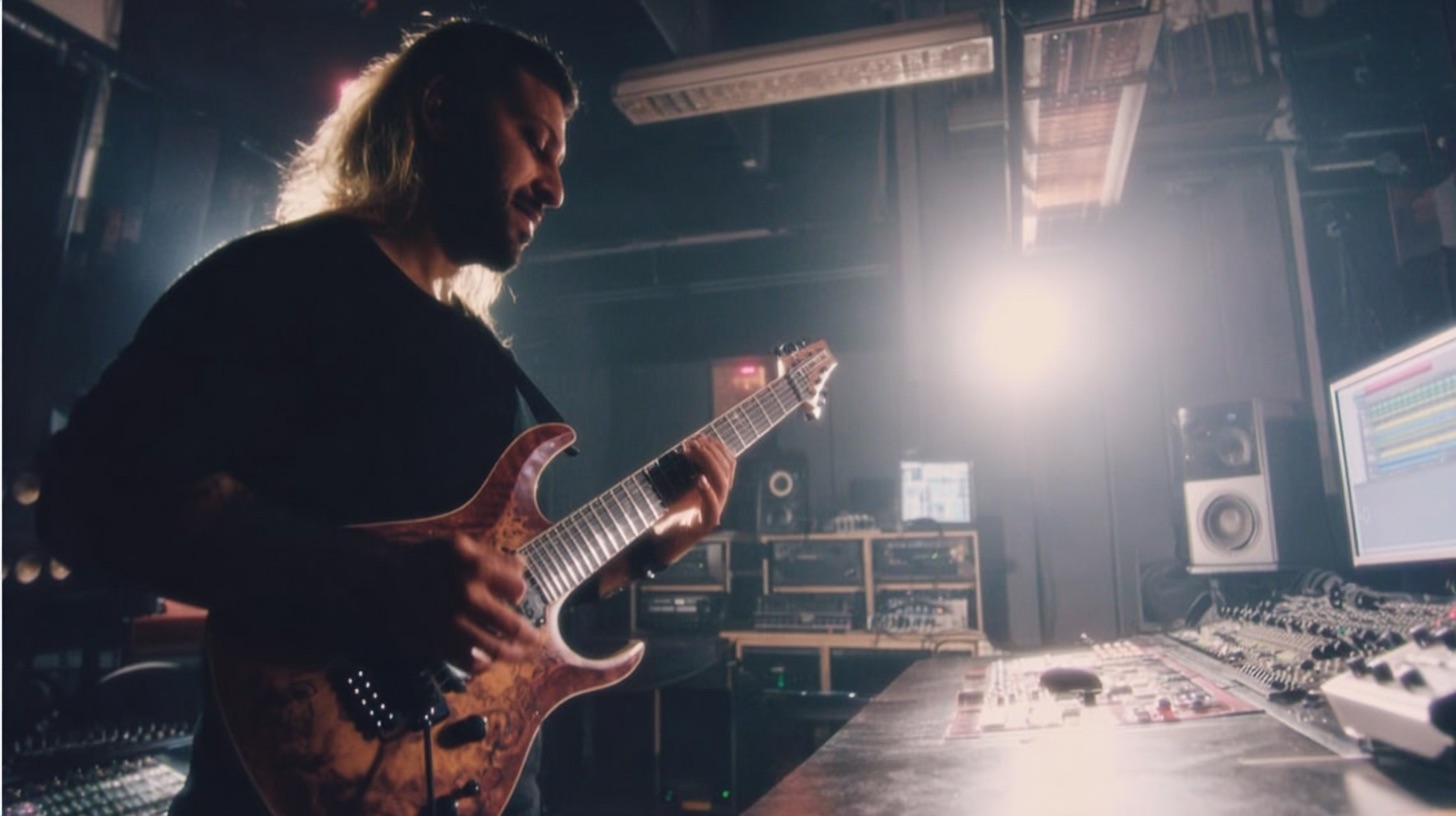
- Extended Range Guitars (7 & 8-String): These are the modern standard for a reason. Guitars like the Kiesel 8-strings are built from the ground up to handle low registers, often featuring multi-scale (fanned-fret) designs that give you a longer scale for the low strings and a shorter scale for the high strings.
The Evertune Bridge: Your Secret Weapon for Tuning
If there’s one piece of hardware that has revolutionized recording low-tuned metal, it’s the Evertune bridge. This thing is a godsend.
When you’re playing that low, especially with heavy-handed rhythm playing, it’s incredibly hard to stay perfectly in tune. Every palm mute can send the note sharp. It’s the same problem bass players face; they often have to tune down 10-15 cents just to compensate for how sharp their attack is. Your choice of pick thickness and material plays a huge role here too, since a thicker pick digs harder and bends the string sharper on every hit. You could try that with guitar, but the higher strings react differently than the low ones, making it a frustrating balancing act.
The Evertune solves all of this. It’s a mechanical system that maintains constant tension on each string, meaning your tuning is rock-solid no matter how hard you pick.
Some players talk about an “Evertune tone tax,” but we don’t buy it. With a fresh set of strings, an Evertune sounds fantastic. The feel for bending is different, for sure, but for tracking brutally tight, perfectly in-tune rhythm guitars, it is an indispensable tool.
Nailing the Performance: Write for the Instrument
You can’t just take a riff you wrote in E standard, play it in Drop F, and expect it to work. A super low-tuned guitar functions differently; think of it less like a viola and more like a cello. It has a different voice and a different role.
This is why you see so many simple, percussive, breakdown-style riffs in modern metal. It’s not a lack of creativity; it’s about playing to the instrument’s strengths. Those low, chunky notes have incredible power, but they need space to breathe. Complex chords or lightning-fast licks on the lowest strings will often turn into an undefined, muddy mess. When writing, focus on rhythm and impact, and let the sheer weight of the tuning do the heavy lifting.
The Real Magic: Advanced Mixing for Low-Tuned Guitars
Okay, you’ve got a killer guitar with an Evertune, and you’ve tracked some perfectly performed, bone-crushing riffs. You’re still not done. In fact, the most critical part is next: the mix.
This is where you tame the beast. A raw, low-tuned DI has a ridiculous amount of low-frequency energy that will completely overtake your mix and clash with your bass and kick drum if you don’t control it.
Producers like Buster Odeholm are masters at this. His low-tuned guitar tones are massive yet clear, and it comes down to one thing: layers of control. It’s not about finding one magic plugin; it’s about a chain of processors, each doing one small job perfectly. If you’re reamping your DIs through real amps, the signal chain matters just as much—see our advanced guitar reamping guide with Sam Pura for a deep dive into mic placement, preamp gain staging, and phase alignment. And if you want a proven dual-mic approach that’s powered some of metal’s most iconic tones, study Fredrik Nordström’s Fredman technique. And if the band didn’t track DI signals at all, don’t panic—Andrew Wade shows how to re-cab guitars using just the amp recording. And for a masterclass in choosing and blending multiple guitar mics, check out how David Castillo handles multi-mic guitar tone on Decapitated. For a hybrid approach that combines a real amp head with digital cab simulation, see how Sam Guaiana uses a Revv 120 with a reactive load and plugin cab sim for Intervals. For a metalcore perspective on building tone through quad-tracked Kemper profiles—using two complementary mid-focused and heavy layers—see how Henrik Udd mixes Dayseeker’s “Sleeptalk” guitars. For a deep dive into how Carl Bown sculpts BFMV’s lead guitar tone using a Marshall JCM800-style Kemper profile with surgical EQ and dynamic compression, see the Bullet For My Valentine lead guitar mixing breakdown. For a look at how producer Andrew Wade builds the Wage War guitar tone through deliberate pick selection and pre-amp EQ—starting from a Kemper profile—see his breakdown of the Wage War guitar tone secrets. For a focused look at the Fredman dual-SM57 micing technique as used on one of modern metal’s most recognizable guitar tones, see Fredrik Nordström’s BMTH micing and EQ hacks. For a look at how Sam Guaiana applies those hybrid amp techniques to create lead guitar melodies that function as the melodic centrepiece of the Intervals mix, see his breakdown of the Intervals lead guitar and melody approach.
Surgical EQ is Non-Negotiable
Forget just scooping the mids. Taming low-tuned guitars requires a much more surgical approach to EQ.
- Aggressive High-Pass Filter (HPF): This is your most important tool. You need to cut out all the unnecessary sub-bass rumble. Start your HPF around 80-100Hz and push it up until the guitar starts to sound thin, then back it off just a touch. This single move cleans up the mud and makes space for the kick and bass to do their job.
- Find and Tame the Fizz: Use a narrow Q to sweep the high frequencies (5kHz and up) to find those harsh, static-y fizz frequencies and pull them down. This cleans up the tone without making it sound dark.
These are fundamental EQ moves for metal. To see how top-tier producers apply these strategies in detail, check out our guide on EQ Strategies for Mixing Modern Metal. For a real-world example of how a world-class producer blends multiple guitar layers—boosted and unboosted—to build a defined progressive metal wall of sound, see Jens Bogren’s approach to mixing Leprous rhythm guitars.
Taming the Beast with Multi-band Processing
This is where the pros really separate themselves. Instead of applying compression or distortion to the entire guitar signal, they use multi-band processors to treat different frequency ranges independently.
Multi-band Compression
A standard compressor will react to the loudest part of your signal—which, with low-tuned guitars, is always the low-end “chug.” This can cause the mids and highs to “pump” unnaturally.
With a multi-band compressor like the FabFilter Pro-MB, you can apply heavy compression only to the low-end (say, below 250Hz). This keeps your palm mutes tight and consistent without squashing the bite and aggression in your midrange. It gives you incredible control over the dynamics. For a deeper dive into this, explore our hub on Metal Compression Secrets. To see this approach in action on some of the heaviest music being made today, check out how Josh Schroeder uses dynamic multiband compression on Lorna Shore’s guitars.
Multi-band Distortion
Here’s the real next-level trick. Using a multi-band saturator like FabFilter Saturn or iZotope Trash 2, you can apply different types of distortion to different parts of your tone.
Imagine this:
- Lows (below 200Hz): Keep them relatively clean and tight to maintain clarity and punch.
- Mids (200Hz – 2kHz): Hit this band with aggressive distortion to get that classic grind and character.
- Highs (above 2kHz): Use a different, brighter saturation to add sizzle and attack without adding harshness.
By blending these layers, you are essentially building your perfect guitar tone piece by piece, with absolute control over every aspect of the sound. For a real-world example of this layered approach, see how Carson Slovak blends dual Diezel amp sim profiles and bus processing to craft Erra’s crushing rhythm tone. For an even more creative layering trick, see how Daniel Braunstein pitch-shifts the DI down one octave as a sub layer on Spiritbox’s guitars. And for a deep dive into integrating synth layers alongside guitars, see how Sam Guaiana uses saturation, stereo widening, and strategic EQ to blend synths behind Intervals’ guitar work. For a symphonic metal take on layering non-traditional elements, see how Fleshgod Apocalypse’s producer uses surgical EQ, humanization, and strategic compression to blend orchestral strings into a metal mix. For a deep dive into how Henrik Udd uses unconventional saturation tools, multiband compression, and a deliberate panning approach to build Architects’ crushing metalcore guitar tone, see the Architects guitar tone breakdown.
Bringing It All Together
Recording modern, low-tuned metal guitar is an art of control. It’s about using the right gear to solve inherent physical problems and then using advanced, layered mixing techniques to shape that raw power into a clear, devastatingly heavy tone. For a masterclass in analog tone crafting, see how Kurt Ballou uses dual amps, contrasting speaker choices, and multi-mic phase alignment to build Converge’s guitar sound. For a real-world look at wrangling quad-tracked rhythm guitars from a legendary metal band, see how Joel Wanasek uses pre-EQ limiting and aggressive filtering on Machine Head’s guitars. For a different challenge—making lead guitars stand out when you have no DI tracks to re-amp—see how Dave Otero carves a unique space for Allegaeon’s leads using tape delay and surgical EQ.
- Start with the right instrument: Use a baritone, 7-string, or 8-string, and seriously consider an Evertune bridge.
- Write for the tuning: Leverage the power of low notes with percussive, impactful riffs.
- Mix with surgical precision: Use aggressive filtering and layers of multi-band processing to control the low-end and shape your tone. And before those DIs even hit an amp sim, make sure they’re surgically tight—our guide to editing metal guitars in Cubase shows Joey Sturgis’s workflow for preserving pick attack while locking every note to the grid. For an even more granular editing approach, see how Zach Jones removes individual pick transients to create Veil Of Maya’s razor-tight guitar sound. For a quick but game-changing Cubase workflow hack—using Auto Fade to eliminate click artifacts at every edit point automatically—see how to use Cubase’s Auto Fade for surgically tight metal guitar edits.
These techniques are the foundation of nearly every modern metal record. But seeing them in action is a completely different experience. If you want to watch producers who live and breathe this stuff build tones like this from scratch, explaining every plugin, setting, and decision along the way… that’s exactly what we do at Nail The Mix.
See how the pros mix modern metal and unlock your sound beyond presets.