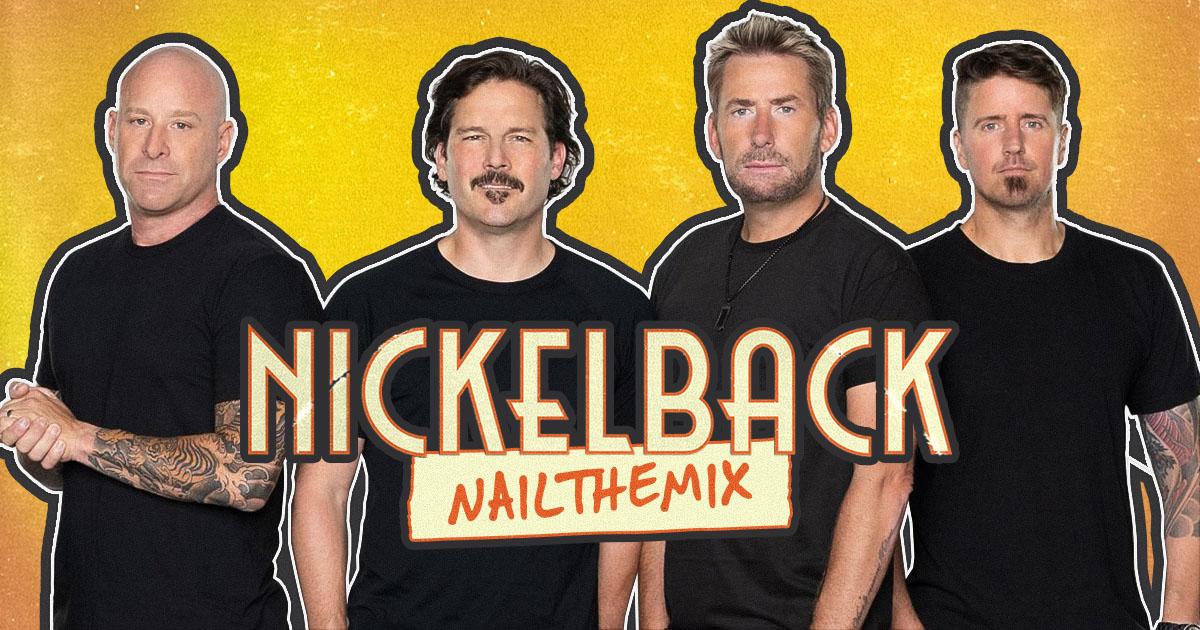
Workflow Hacks for Mixing Massive Rock Songs (ft. Nickelback)
Nail The Mix Staff
Let’s be real: when a Nickelback track comes on, you know it. The sound is massive, polished, and powerful. It’s the kind of high-octane rock mix that many producers spend years trying to achieve. So how does mixer and producer Chris Baseford (Nickelback, Shinedown, Rob Zombie) get that larger-than-life sound?
If you think the answer is some ultra-secret, expensive plugin, you’re dead wrong.
The key to Baseford’s results isn’t about what he’s using, but why and how fast he’s using it. It’s a philosophy built on speed, instinct, and eliminating the one thing that kills most sessions: decision fatigue. Let’s break down his approach to building a huge rock mix and how you can apply these workflow hacks to your own sessions.
Ditch the Decision Fatigue: The “Why” Over a Thousand “Whats”
How often does this happen to you? A track has too much low-end mud. You click to add a plugin and are suddenly staring at dozens of EQs. “Should I use the Neve for warmth? The API for punch? Or maybe FabFilter for surgical precision?”
According to Chris, that moment of hesitation is a waste of creative energy. Every second you spend agonizing over which tool to use is a second you’re not actually mixing. The goal is to identify a problem and solve it instantly.
Build a Go-To Workflow
Chris’s solution is brutally effective: he puts an SSL Channel Strip on every single track in his template. Why? Because if a track needs anything—a high-pass filter, a bit of top-end sparkle, some light compression—the tool is already there. No menus, no searching, just immediate access.
He takes it a step further by using a physical plugin controller that mimics the SSL console, allowing him to grab a real knob and make a move without even looking at the screen.
Actionable Tip: You can do this right now in any DAW. Create a project template where every audio track already has your favorite, most versatile channel strip loaded on it. It could be from Slate Digital, Universal Audio, Waves, or the stock EQ and compressor in your DAW. The goal isn’t which one you pick; it’s about having your tools ready to go so you can move at the speed of thought. This approach lets you focus on your EQ strategies instead of your plugin list.
Deconstructing Nickelback’s Legendary Kick Drum
That signature Nickelback kick drum sound isn’t one magic sample. It’s a custom-built weapon, forged specifically for each song during the production process. This approach ensures the kick supports the track from the ground up, rather than trying to force a generic sample to fit later.
Layering for Power: It’s a Production Process
The final kick sound is a carefully constructed blend. Here’s how it’s built:
- The Foundation: It starts with the live, miked acoustic kick drum. This provides the organic feel and body of the performance.
- The Core Punch: During production, Chris creates programmed drum parts. Once they have a kick sound they love from those programmed drums, he prints it as a new audio file. This “production sample” is then layered with the live kick, creating a sound the band is already familiar and comfortable with. It’s a common technique for mixing with samples to get the best of both worlds.
- The “Money Maker”: Often, that “production sample” is already a blend of 3-4 different samples, processed and EQ’d together to create the perfect sound for the song. By the time he gets to the final mix, that complex sound is already baked into a single, easy-to-use sample.
- Filling the Gaps: At one point, he noticed the kick needed a bit more “slap.” Instead of trying to EQ it in, he simply added another sample that had the specific “slappy” attack he wanted and blended it in.
The Secret to Sustain: Ambient Samples and Length
One of Chris’s most valuable drum-mixing techniques is focusing on sustain. He wants drum hits, especially kicks and snares, to fill the space until the next beat arrives. A dry, punchy sample often dies out too quickly, leaving awkward gaps in the energy.
To solve this, he blends in big, long, ambient drum samples. These aren’t meant to be the primary sound, but when mixed in subtly, they give the kick a sense of realistic space, width, and length. They help the drum sustain in a way that feels powerful and natural, gluing the rhythm section together.
Fast and Loose: Why Your EQ Settings Don’t Need to Be Precious
When Chris shows the EQ on his final kick bus, it’s a masterclass in his “why over what” philosophy. He points to a high-shelf boost and admits he probably didn’t even touch the frequency selector. It’s set to 8kHz simply because that’s the default.
The thought process was:
- The Why: “Does the kick need more top-end?” Yes.
- The How: Turn up the high-shelf knob.
- The Result: “Did that fix the problem without creating new ones?” Yes. Move on.
He didn’t agonize over whether 7k or 9k would be better. He made a broad, musical stroke that served the song and kept moving. This same idea applies to compression; if you know you need fast, aggressive peak-leveling, you grab an 1176-style compressor and dial it in quickly. The goal is to get the sound you hear in your head, not to copy a preset. Developing this instinct is one of the most powerful compression secrets there is.
This is a discipline that even the pros have to work on. It means fighting the urge to hunt for a magic bullet and trusting your ears to make fast, effective decisions.
The Speeding Ticket Test: Serving the Song, Not the Mix
At the end of the day, what’s the goal of a hard-hitting rock mix? Chris has the perfect metric: the “speeding ticket test.”
He says, “If a hundred people got speeding tickets while this song was playing, my job as a producer is fulfilled.”
The mix isn’t there to show off a cool snare sound or a complex EQ curve. It’s there to create pure, visceral emotion. If a listener is driving and gets so caught up in the energy that their foot gets a little heavier on the gas, the mix is a success. If they’re instead thinking, “Hmm, that kick drum has a lot of low-end pump,” the mix has failed because a technical detail pulled them out of the experience.
Every decision—from layering drum samples to a quick EQ boost—must serve that ultimate goal.
Ready to Build Your Own Massive Mixes?
The concepts Chris Baseford uses are fundamental to creating professional-sounding rock and metal. It’s about building a workflow that lets you be creative and decisive.
Nickelback on Nail The Mix
Chris Baseford mixes "San Quentin"
Get the Session
You can watch Chris apply this exact philosophy as he mixes a Nickelback song from scratch in his full session, available on our sessions page. You get the real multi-tracks to practice on, plus access to our entire vault of courses and a community of dedicated producers.
Start building faster, more intuitive workflows today. See every move, every decision, and learn the “why” behind a world-class mix by checking out the Nickelback session with Chris Baseford.