How Tom Lord-Alge mixes Tom Delonge’s Vocals (ft. Angels & Airwaves)
Nail The Mix Staff
Let’s be real, Tom DeLonge’s voice is one of the most distinct in modern rock. That unmistakable SoCal punk energy is his signature, but when he launched Angels & Airwaves, the production took that signature and launched it into the stratosphere. The vocals on albums like We Don’t Need to Whisper and I-Empire are drenched in spacey, atmospheric effects that became a core part of the band’s sound.
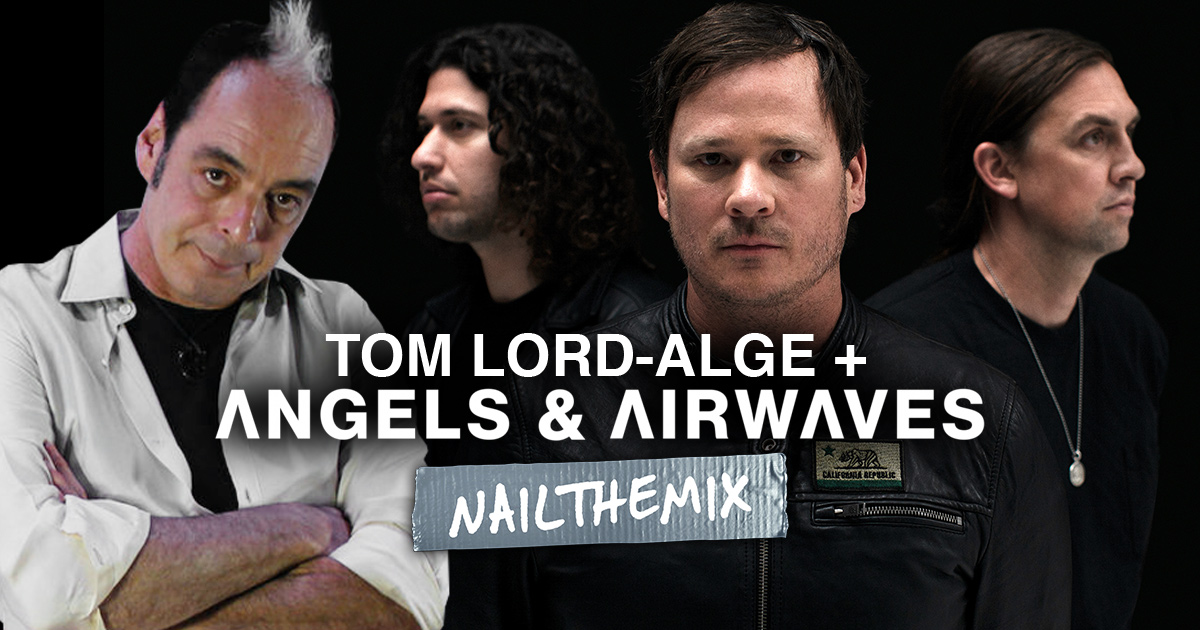
Ever wonder how that sound was crafted? We got an inside look at the multitracks with legendary mixer Tom Lord-Alge to see exactly how he treated Tom’s vocals for AVA’s debut. TLA’s approach is a masterclass in taking a band’s initial vision and owning it, transforming a good performance into something iconic. It’s all about aggressive processing, creative effects chains, and smart organization. Let’s dive into his signal chain.
The Foundation: Aggressive EQ and Compression
Right off the bat, TLA makes it clear he’s not going for subtlety. His goal was to make Tom’s vocal aggressive—to get it to “spit and bark” at the listener. While the raw vocal track was a solid recording, he knew it needed some serious shaping to cut through the massive wall of sound in an Angels & Airwaves track.
His philosophy is simple: don’t be afraid to be heavy-handed. While tiny, surgical moves have their place, TLA pushes his tools hard to get the character he’s hearing in his head.
EQ Into Compression
One of the cornerstones of TLA’s vocal chain is his processing order. He nearly always puts his EQ before his compression.
Why? It gives you a specific kind of control. By placing an EQ first, you can boost the frequencies you want to emphasize—like adding that top-end air and sparkle to a vocal. When that boosted signal hits the compressor, the compressor naturally grabs onto those louder peaks and pulls them back a bit. The result is that you get all the brightness and presence you wanted, but in a way that feels controlled and glued together, not harsh or pokey. It’s a classic technique for getting a vocal to sound polished and expensive.
Getting the Vocal to “Bite”
For Tom’s vocal, TLA used the Focusrite D2 EQ to carve out the tone, followed by some serious compression. The goal wasn’t just to control dynamics; it was to create an effect. He was trying to emulate the sound of a mic pre being pushed into overload, but in a more controlled, modern way.
If you A/B’d the raw vocal with TLA’s processed version in solo, you might think the processed one sounds over-the-top or harsh. But as TLA points out, the raw, unprocessed track isn’t a “real-world reference point.” The only reference that matters is how it sounds in the context of the full mix. That aggressive, biting vocal that sounds like a bit much on its own is exactly what’s needed to sit on top of the dense layers of guitars, synths, and drums.
Crafting That Signature Spaced-Out Reverb
The pre-delayed reverb is arguably the most recognizable element of the Angels & Airwaves vocal sound. TLA took the band’s initial idea for this effect and evolved it into something truly special. It’s not just about slapping a reverb on a send; it’s a carefully constructed chain.
The Pre-Delay Trick: Use a Separate Delay
Instead of relying on the pre-delay knob built into most reverb plugins, TLA builds the effect himself for maximum control.
Here’s the chain:
- He puts a delay plugin first on his effects bus.
- He sets the delay time and adds some feedback for a few repeats.
- After the delay, he places his reverb plugin—in this case, the Valhalla Vintage Verb on the Concert Hall setting.
This creates a distinct “slap” of the vocal before the reverb wash swells up, giving the vocal space and clarity before the ambiance kicks in.
A Pro Move: De-Essing the Reverb Send
Here’s a killer trick that makes a huge difference. TLA puts a de-esser on the vocal send before it even hits the delay and reverb chain. Why? Reverbs can easily exaggerate sibilance (those harsh “s” and “t” sounds), resulting in a “sandy,” washy sound that can be really annoying. By de-essing the signal on its way to the effects, he ensures the reverb is triggered by the body and tone of the vocal, not the harsh sibilance. This keeps the reverb smooth and pleasant without affecting the main vocal track.
Automation: Making the Reverb Breathe
The final piece of the puzzle is automation. TLA automates the level of the reverb send so that it “sucks up” and swells in the gaps between vocal phrases. This makes the effect feel dynamic and interactive, filling the space when Tom isn’t singing and tucking itself neatly away when he is.
Organization and Section-Specific Effects
TLA is a big believer in organization for the sake of creativity. Instead of having one vocal track and automating everything on it, he splits the performance into multiple tracks based on the song section. He’ll have separate tracks for the verse, the chorus, the bridge, and so on.
This makes it incredibly easy to apply different processing to each section. The chorus might need more compression and a wider effect, while the verse might be drier and more intimate.
The Chorus: Going Wide
On this mix, TLA wanted the chorus to feel huge. To do this, he took the main vocal and the double and panned them slightly to the left and right. This is a departure from the common practice of keeping the lead vocal dead center. By spreading the chorus vocals out, he created a panoramic width that makes the section explode.
The Bridge: Classic ADT Meets Modern Sweeps
For the bridge section, TLA combined effects provided by the band with his own classic tricks. He started with a “sweepy vocal delay” that the band had already printed. To thicken up the vocal itself, he added an ADT (Automatic Double Tracking) effect.
This isn’t a true double-track; it’s an effect created with a very tight, modulating slap delay, almost like a flanger. Think of the psychedelic vocal sounds on The Beatles’ “I Am The Walrus”—that’s ADT. TLA places this effect before his main EQ and compression chain. He then did a cool automation move: as the band’s sweepy delay fades out, TLA fades in his own heavily processed reverb to fill the space, creating a seamless and massive transition.
Making It Your Own
The big lesson from Tom Lord-Alge’s session is to be bold and creative. He combines foundational techniques like EQ strategies with inventive effects routing and automation to serve the song.
- Be aggressive with EQ and compression to make vocals cut through a dense mix.
- Build your own pre-delayed reverbs for ultimate control.
- Use section-specific tracks to apply different effects to verses and choruses.
- Get creative with automation to make your effects dynamic and exciting.
Learning these techniques is one thing. But seeing how a pro actually applies them in real-time, hearing the before-and-after, and understanding the why behind every decision is a total game-changer.
Angels And Airwaves on Nail The Mix
Tom Lord Alge mixes "The Adventure"
Get the Session
That’s exactly what we do at Nail The Mix. Every month, you get the actual multitracks from a massive rock or metal song and watch the original producer mix it from scratch, explaining every single move. If you’re ready to move beyond presets and learn how the pros really craft iconic sounds, this is your chance to learn from the best in the business. Check out how you can unlock your sound and start mixing modern metal today.